

Meta Description: Discover why Penetrant Testing (PT) is critical for Duplex Stainless Steel Flanges (2205, 2507). Learn about defect detection, ASME standards, and quality assurance at Hu Lin Pipe.
Introduction
Duplex stainless steel flanges (such as UNS S31803/S32205 and UNS S32750) are widely utilized in highly demanding industries, including offshore oil & gas, chemical processing, seawater desalination, and subsea pipelines. Renowned for their superior strength and excellent resistance to chloride stress corrosion cracking, duplex flanges are critical components in high-pressure and corrosive environments.
However, microscopic surface defects introduced during forging, machining, or welding can severely compromise the integrity of these flanges. Liquid Penetrant Testing (PT) is a vital non-destructive testing (NDT) method used to detect surface-breaking discontinuities, ensuring the absolute reliability and safety of duplex flange connections.
What is Liquid Penetrant Testing (PT)?
Liquid Penetrant Testing (PT), also known as Dye Penetrant Inspection (DPI), is a highly sensitive, cost-effective NDT method used to locate surface-breaking defects in non-porous materials.
The PT Inspection Process
The standard PT procedure follows a strict 6-step methodology:
- Pre-Cleaning: The flange surface (especially the sealing face and weld areas) is thoroughly cleaned to remove oil, grease, scale, and machining fluids.
- Penetrant Application: A highly fluorescent or visible dye penetrant is applied and allowed to dwell (typically 10–30 minutes), seeping into any surface defects via capillary action.
- Excess Removal: The surface is carefully cleaned to remove excess penetrant without drawing the dye out of the defects.
- Developer Application: A thin, uniform layer of developer is applied to draw the trapped penetrant back to the surface, creating a visible indication.
- Inspection: Inspectors examine the surface under appropriate lighting (UV-A light for fluorescent penetrants, or high-intensity white light for visible dyes).
- Evaluation & Reporting: Indications are measured, evaluated against strict acceptance criteria, and documented in a formal NDT report.
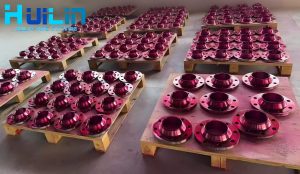 Why PT is Critical for Duplex Stainless Steel Flanges
1. Detecting Microscopic Surface Defects
Duplex flanges undergo rigorous manufacturing processes including hot forging, CNC machining, and heat treatment. These processes can introduce microscopic surface flaws such as forging laps, micro-cracks, grinding cracks, or quench cracks. PT can detect defects as narrow as 0.025mm, which are completely invisible to the naked eye but can act as initiation points for catastrophic failure.
2. Ensuring Sealing Surface Integrity
The flange face (e.g., Raised Face, RTJ) is the primary sealing surface. Any surface-breaking defect in this critical zone can create a leak path under high pressure or extreme temperatures, leading to dangerous fluid escapes, environmental contamination, and costly unplanned shutdowns.
3. Verifying Weld Quality
For welded-neck or lap-joint duplex flanges, the weld zone is highly susceptible to defects like porosity, undercut, crater cracks, and incomplete fusion. PT is essential to verify the surface integrity of these welds, ensuring they meet the stringent requirements of pressure piping codes.
4. Overcoming the Limitations of Magnetic Particle Testing (MT)
Unlike carbon steel, duplex stainless steel has a mixed microstructure (roughly 50% austenite and 50% ferrite). Because the austenitic phase is non-magnetic, Magnetic Particle Testing (MT) is often ineffective or unreliable for detecting defects in duplex materials. PT is the preferred and most reliable surface NDT method for duplex alloys.
5. Compliance with International Codes and Standards
Major international pressure equipment codes mandate or highly recommend PT for duplex flanges used in critical service:
- ASME B16.5 / B16.47: Pipe Flanges and Flanged Fittings
- ASME BPVC Section VIII: Pressure Vessels
- NORSOK M-650: Qualification of manufacturers of high integrity duplex stainless steel components (Offshore)
- ISO 17781: Petroleum and natural gas industries
Acceptance Criteria for Duplex Flanges
At Hu Lin Pipe, PT inspections are strictly evaluated against the highest industry standards. Generally, the acceptance criteria for critical duplex flanges dictate:
- Cracks and Linear Indications: Strictly zero tolerance. Any indication identified as a crack is an immediate reject.
- Rounded Indications (Porosity/Inclusions): Evaluated based on size, frequency, and clustering, strictly following ASME Section VIII, Div. 1, Appendix 8 or equivalent client specifications.
- Sealing Surfaces: Often subject to even tighter “zero defect” tolerances depending on the project’s specific engineering requirements.
Quality Assurance at Hu Lin Pipe
At Hu Lin Pipe, quality is not just a checkpoint; it is embedded in our manufacturing DNA. For our duplex stainless steel flange production, we enforce rigorous NDT protocols:
- Certified Personnel: All PT inspections are conducted by ASNT Level II and Level III certified NDT technicians.
- Advanced Equipment: We utilize both Type I (Fluorescent) and Type II (Visible) penetrant systems, supported by calibrated UV-A lamps and high-intensity white light inspection booths.
- Full Traceability: Every flange batch is accompanied by comprehensive documentation, including Mill Test Certificates (MTC) and detailed NDT reports.
- Strict Adherence: Our processes comply with ASTM E165, ASTM E1417, and ISO 3452 standards.
Conclusion
In critical piping systems, the cost of a flange failure far outweighs the cost of rigorous quality inspection. Penetrant Testing (PT) serves as the ultimate safeguard against surface defects in duplex stainless steel flanges, ensuring leak-free performance, operational safety, and long-term reliability.
By choosing Hu Lin Pipe, you are investing in duplex flanges that have been meticulously inspected and verified to meet the highest global standards.